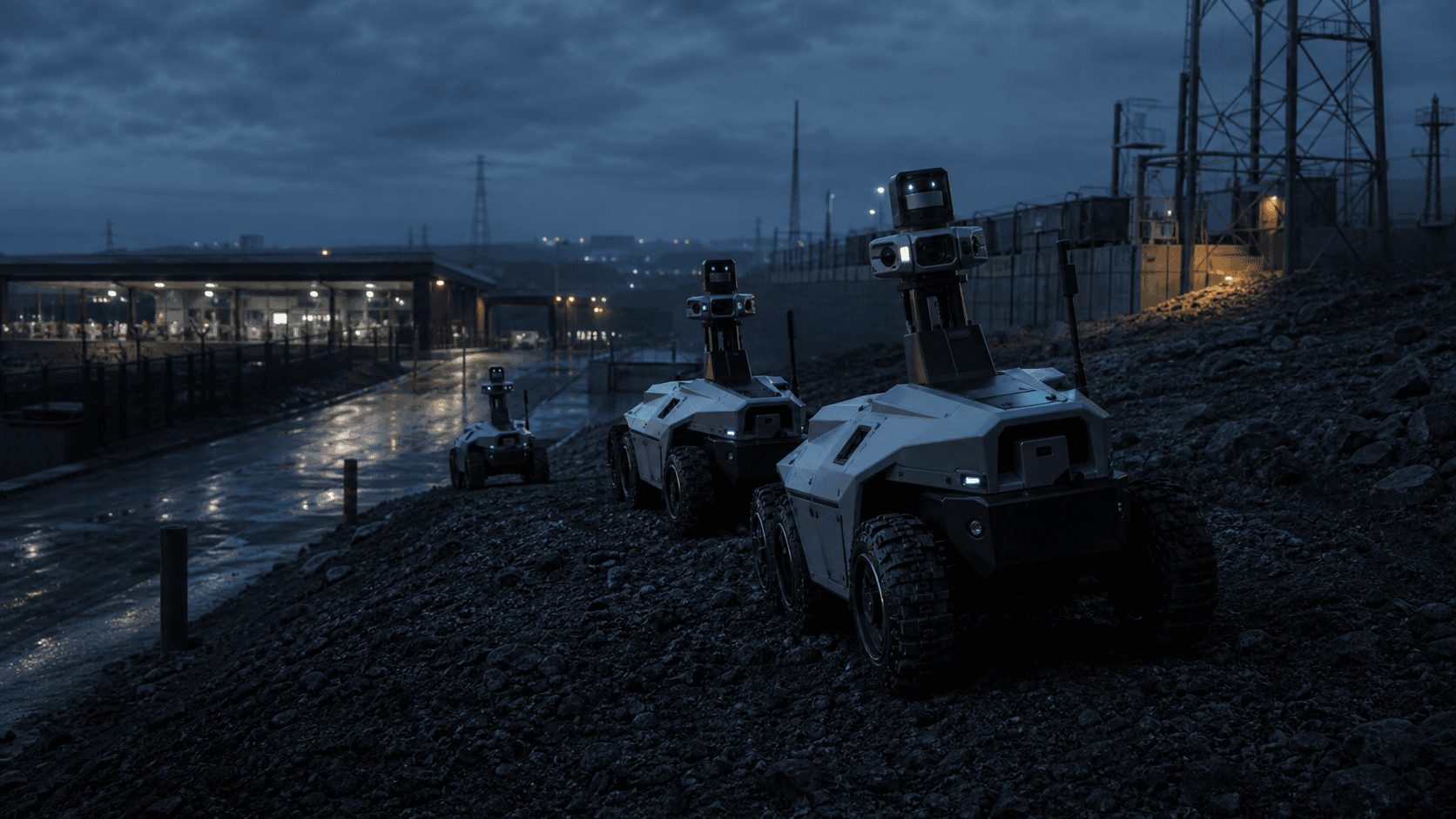
A mission can be described in one sentence. Robot motion cannot. Between “inspect the eastern perimeter” and a platform beginning to move sits a dense set of questions about maps, payloads, battery state, communications, right-of-way, geofences, operator authority, and recovery behavior.
The reliable way to manage that gap is a control plane: a governed workflow that translates mission intent into platform-specific tasks without allowing a planning model to command hardware directly.
The agent proposes mission structure. The control plane proves that the structure is admissible. The platform adapter executes only the released task.
Separate mission semantics from platform commands
A planner should reason in mission concepts such as inspect, observe, deliver, hold, or return. A robot controller operates on routes, poses, velocities, modes, and payload commands. Binding those layers too early makes the workflow brittle and gives the planning layer more authority than it needs.
A better architecture preserves three distinct representations:
- Mission intent: the desired outcome, priority, area, and completion criteria.
- Governed task plan: assigned platforms, ordered tasks, constraints, and release conditions.
- Platform command: the exact ROS 2, MAVLink, MQTT, or vendor-specific payload sent after approval.
The governed task plan is the contract between reasoning and motion. It is structured enough to validate and inspect, yet independent of a specific robot API.
Capability matching is a live decision
A fleet registry should describe what each platform can do, but assignment cannot rely on static labels alone. The same robot may be suitable at 90 percent battery and unsuitable at 28 percent. A sensor payload may be installed but unavailable. A route may be traversable in dry weather and invalid after a condition update.
Capability matching therefore evaluates live state alongside declared capability:
| Check | Example question | Failure posture |
|---|---|---|
| Platform | Is the assigned robot healthy and available? | Select another platform or hold |
| Payload | Is the required sensor present and calibrated? | Request maintenance evidence |
| Environment | Is the route valid for current terrain and weather? | Replan inside the approved area |
| Energy | Can the robot complete the task with reserve? | Reduce scope or return |
| Authority | Is this task released for this platform and time? | Block command emission |
These checks should execute again immediately before command emission. A valid plan can become invalid while it waits for approval.
Make the safety envelope executable
Operational constraints are often written in prose: remain inside the corridor, maintain reserve, avoid restricted zones, stop when localization confidence falls. A governed workflow converts those statements into explicit predicates evaluated against the task plan and live telemetry.
The envelope should cover spatial limits, temporal windows, energy reserve, speed or payload constraints, communications posture, and permitted recovery modes. A failed predicate should identify the exact fact and rule that blocked the task. “Policy failed” is not enough for an operator who must decide what to do next.
The envelope also needs ownership. Operations should be able to see which rule set is active, who changed it, and which missions are bound to that version. Otherwise a policy edit can silently alter the meaning of an already-approved plan.
Release an immutable task package
Human approval is most useful after validation but before actuation. The operator should review a stable task package containing the route, platform assignment, key constraints, expected duration, recovery posture, and evidence used by the planner.
Once released, that package should be immutable. If a change affects route, platform, payload, scope, or authority, the system creates a new version and returns to the appropriate validation step. Minor runtime adaptations may remain inside a pre-approved envelope, but the boundary must be explicit.
This versioning prevents a subtle failure mode: an operator approves one plan while the agent continues modifying another.
Checkpoint before the next side effect
Robotic workflows interact with systems that do not always support transactions. A command may reach a platform even if the application loses connectivity before recording the response.
For that reason, effectful steps should execute in stable order and checkpoint before the next side effect begins. The checkpoint records the released payload, dispatch attempt, platform acknowledgement, and observed state. On resume, the workflow can distinguish “not sent” from “sent but response unknown” and avoid duplicate motion commands.
Design recovery as a first-class path
Recovery is not an error screen. It is part of the mission graph. Common postures include hold position, continue locally inside a narrow envelope, return to a known point, transfer control to an operator, or terminate the task safely.
Each platform class may require a different response, but the control plane should expose the same operational questions: what triggered recovery, which constraints remain valid, what the robot is doing now, and what authority is required to resume.
A fleet becomes dependable when mission intent can travel through planning, policy, release, dispatch, observation, and recovery without any layer pretending to be another. Intelligence creates options. The control plane turns only authorized options into motion.